Before You Spend Another £2,000 Fixing Your Store, Find Out Whether Anything Is Actually Broken
Most marketplace sellers waste £10K–£25K solving the wrong problems at the wrong stage. This diagnostic tells you what to focus on, and what NOT to touch yet.
✅ Immediate Delivery | ✅ Money-Back Guarantee | ✅ One-Time Payment
Every Successful Transition Follows The Same Five Stages
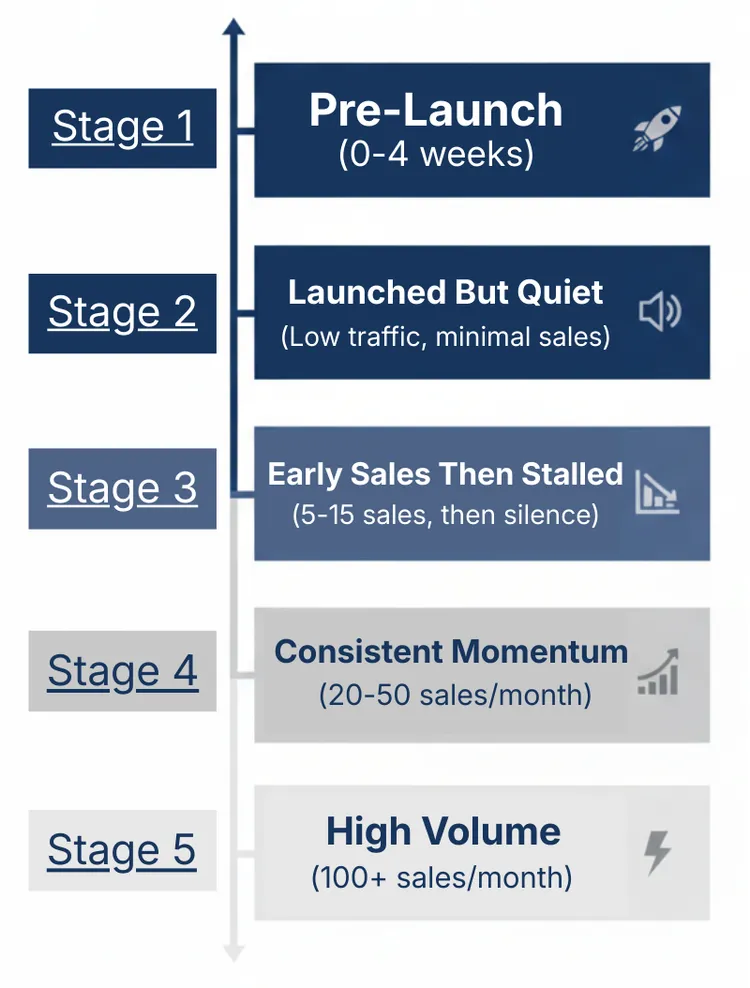
Every Successful Transition Follows The Same Five Stages
Most sellers don’t know which stage they’re actually in.
They’re in Stage 2, but hire Stage 4 solutions.
That’s where £10K–£25K disappears.
This diagnostic tells you which stage you’re in, and what not to spend money on yet.
Here’s What’s Actually Happening
Here’s What’s Actually Happening
You launched your store.
You waited.
And… silence.
Maybe a few visitors.
Maybe a sale or two.
But nothing like what you were used to on Amazon or Etsy.
So your brain does what it was trained to do:
"Is my website broken?"
"Are my products wrong?"
"Is my traffic too cold?"
"Do I need better photos?"
"Should I hire someone to fix my conversion rate?"
Here’s the uncomfortable truth:
Nothing is broken.
You’re just expecting your owned store to behave like a marketplace.
And it doesn’t.
On a marketplace, buyers arrive with intent.
Trust is borrowed.
Decisions are compressed.
On your own site, none of that exists yet.
That doesn’t mean you’ve failed. It means you’re in a different stage than you think you are.
You launched your store.
You waited.
And… silence.
Maybe a few visitors.
Maybe a sale or two.
But nothing like what you were used to on Amazon or Etsy.
So your brain does what it was trained to do:
"Is my website broken?"
"Are my products wrong?"
"Is my traffic too cold?"
"Do I need better photos?"
"Should I hire someone to fix my conversion rate?"
Here’s the uncomfortable truth:
Nothing is broken.
You’re just expecting your owned store to behave like a marketplace.
And it doesn’t.
On a marketplace, buyers arrive with intent.
Trust is borrowed.
Decisions are compressed.
On your own site, none of that exists yet.
That doesn’t mean you’ve failed.
It means you’re in a different stage than you think you are.
The Mismatch That's Costing You Thousands
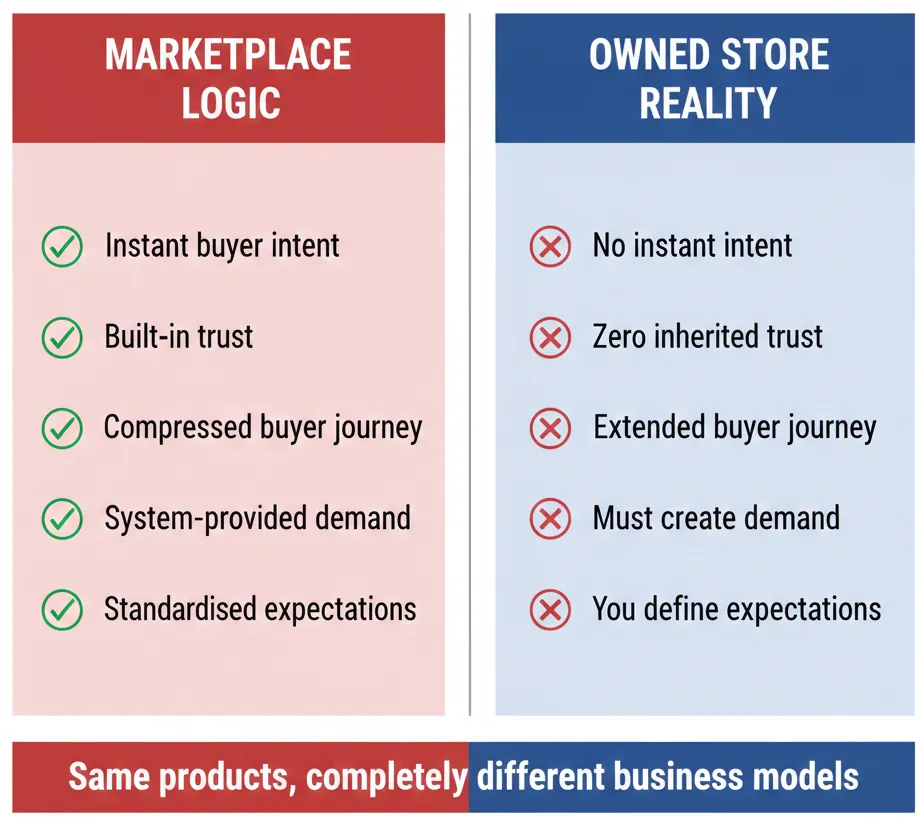
Here's the truth: Nothing is broken.
You're just applying marketplace logic to a completely different business model.
Every single assumption Amazon trained into you (instant intent, built-in trust, compressed buyer journeys) none of it exists on your owned store.
This isn't a problem with your store. This is the fundamental difference between the two business models.
Ready to find out which stage you're actually in?
✅ Immediate Delivery | ✅ Money-Back Guarantee | ✅ One-Time Payment
Why Your Numbers Look "Wrong" (They're Not)
On Amazon, you might see:
8-12% conversion rates
Buyers purchasing within 5 minutes
High intent from day one
On your owned store, you're seeing:
1.4-1.8% conversion rates (if you're average)
Visitors leaving and coming back multiple times
Long consideration periods (days or weeks)
Your conversion rate isn't low because something is broken. It's low because you're comparing instant intent + built-in trust to no intent + zero trust.
That's like comparing a Ferrari's speed on a motorway to its speed in a car park and concluding "the Ferrari is broken."
The Expensive Mistake: Solving The Wrong Problem
When sellers see low conversions on their owned store, their marketplace-trained brain says: "I need to optimise conversions."
So they:
Hire a CRO specialist (£2,000-£5,000)
Buy advanced analytics tools (£200-£500/month)
Run A/B tests on checkout flows
Redesign their entire website
Add expensive apps and plugins
Here's the problem: You don't have a conversion problem. You have a trust and intent problem.
Optimising conversions without first building trust-building touchpoints is like:
Optimising your restaurant's table layout when nobody knows your restaurant exists
Fine-tuning your car's engine when you haven't built the roads yet
Perfecting your sales pitch when the prospect doesn't even know who you are
You're solving the wrong problem at the wrong stage.
The Expensive Mistake: Solving The Wrong Problem
When sellers see low conversions on their owned store, their marketplace-trained brain says: "I need to optimise conversions."
So they:
Hire a CRO specialist (£2,000-£5,000)
Buy advanced analytics tools (£200-£500/month)
Run A/B tests on checkout flows
Redesign their entire website
Add expensive apps and plugins
Here's the problem: You don't have a conversion problem. You have a trust and intent problem.
Optimising conversions without first building trust-building touchpoints is like:
Optimising your restaurant's table layout when nobody knows your restaurant exists
Fine-tuning your car's engine when you haven't built the roads yet
Perfecting your sales pitch when the prospect doesn't even know who you are
You're solving the wrong problem at the wrong stage.
The Five Stages Every Successful Transition Follows
The Five Stages Every Successful Transition Follows
Here's what most sellers don't realise: every successful marketplace-to-owned-store transition follows the same five-stage progression.
The waste happens when you:
Skip stages entirely
Operate at Stage 3 tactics when you're actually in
Stage 1
Try to do everything simultaneously instead of sequentially
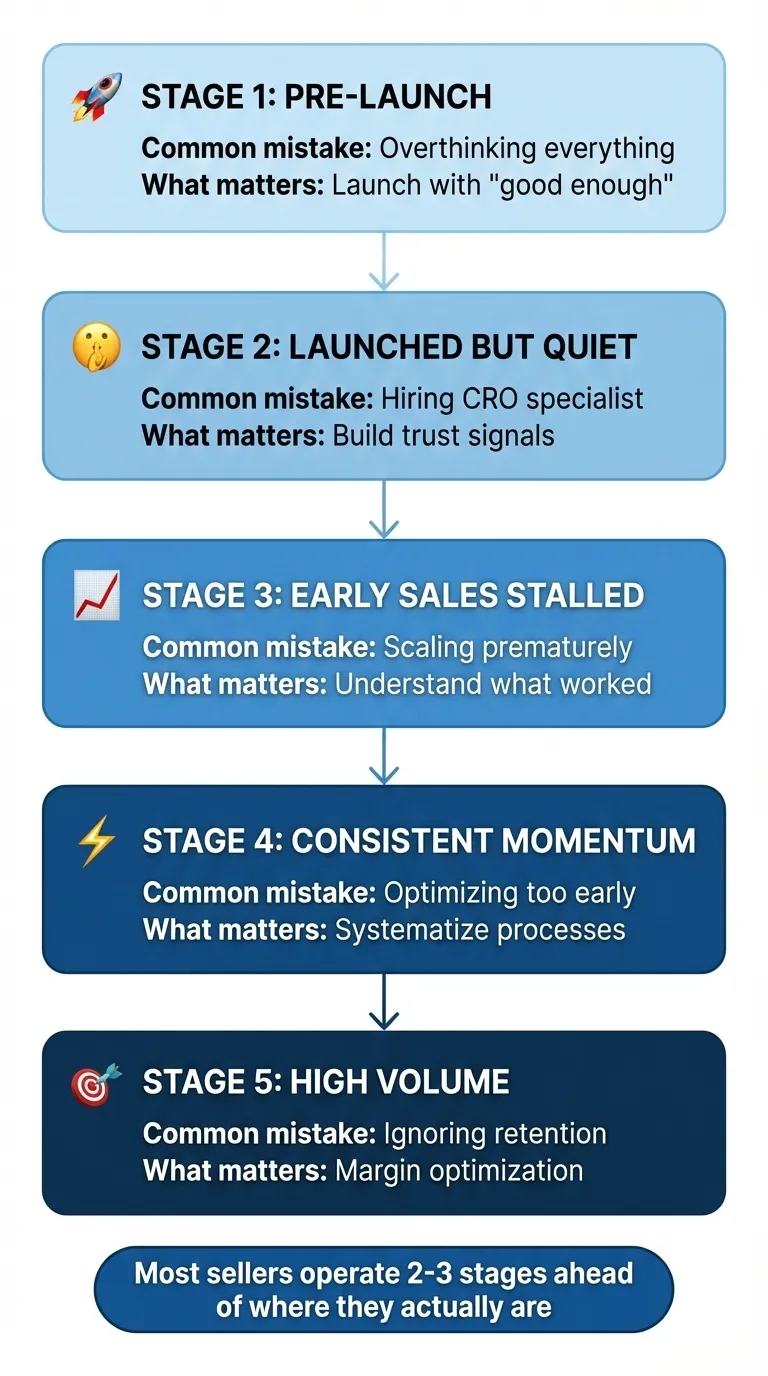
Let me break down what each stage actually looks like (and where you're probably getting it wrong):
Stage 1: Pre-Launch
What it is: You haven’t launched yet, or you launched in the last few weeks.
Common mistake: Perfecting things that don’t matter yet.
What actually matters: Launch. Get real visitors. Learn from reality, not imagination.
Stage 2: Launched But Quiet
What it is: Your store is live. Traffic is low. Conversions are 1–2%. It feels like something must be wrong.
Common mistake: Hiring conversion specialists or running aggressive ads.
What actually matters: Building trust, audience infrastructure, and understanding buyer behaviour.
This is where 70% of sellers waste £10,000-£25,000 by hiring wrong-stage help.
Stage 3: Early Sales Then Stalled
What it is: You made sales. Then momentum slowed.
Common mistake: Scaling prematurely.
What actually matters: Identifying what actually worked and systemising it.
Stage 4: Consistent Momentum
Sales are predictable. Systems matter.
Stage 5: High Volume
Now it’s about retention, margins, and leverage.
The Cost of Stage Misdiagnosis
Here's what happens when you operate at Stage 4 when you're actually in Stage 2:
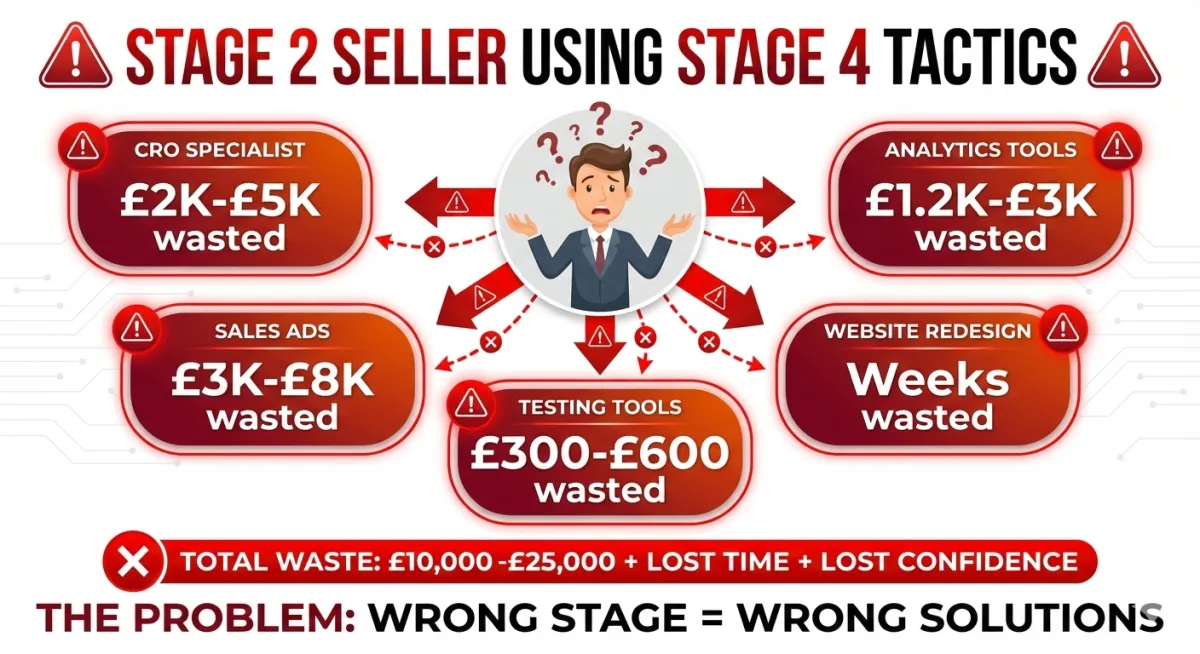
And here's the worst part: You still don't know what stage you're actually in or what to focus on.
This Isn't A Technical Problem. It's A Judgement Problem
You don't have a "my website doesn't work" problem.
You have a "I don't know which stage I'm in, what's normal for that stage, which advice applies to me, or what to focus on first" problem.
Technical problems have technical solutions. Hire the right developer, fix the bug, problem solved.
Judgement problems require diagnosis before action. Without knowing your actual stage, every decision is a guess. And expensive guesses compound.
Why I Created This Diagnostic (And Why I Understand Exactly What You're Going Through)

Eifion Redmond
Founder - EZION AI
"I Made This Mistake First"
For 10 years, I ran a marketplace-led business.
As it grew, I realised something uncomfortable. I didn’t actually control it.
So I decided to build my own site. I assumed it would behave like a marketplace with different fees.
It didn’t.
I hired agencies. Ran ads. Copied competitors.
Sales came in...just enough to stay hopeful, but nothing compounded.
The problem wasn’t effort.
It was stage confusion.
I was applying Stage 4 tactics to a Stage 2 business.
That mistake cost me over £10,000 and nearly a year.
That experience is what led me to systemise the transition into stages.
Ready to avoid the mistake I made?
✅ Immediate Delivery | ✅ Money-Back Guarantee | ✅ One-Time Payment
How The Marketplace Transition Diagnostic Actually Works
This isn't a sales call. This isn't a 30-minute surface audit.
This is a custom analysis of your specific situation delivered as a written report you can reference repeatedly.
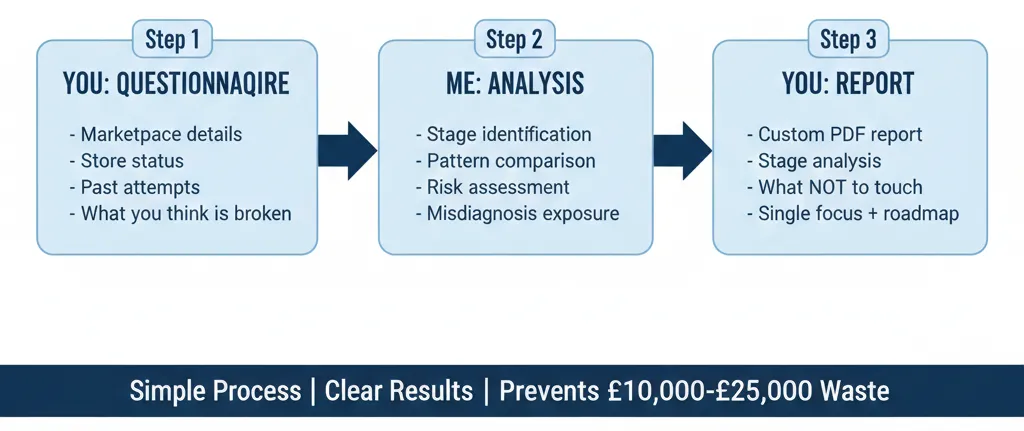
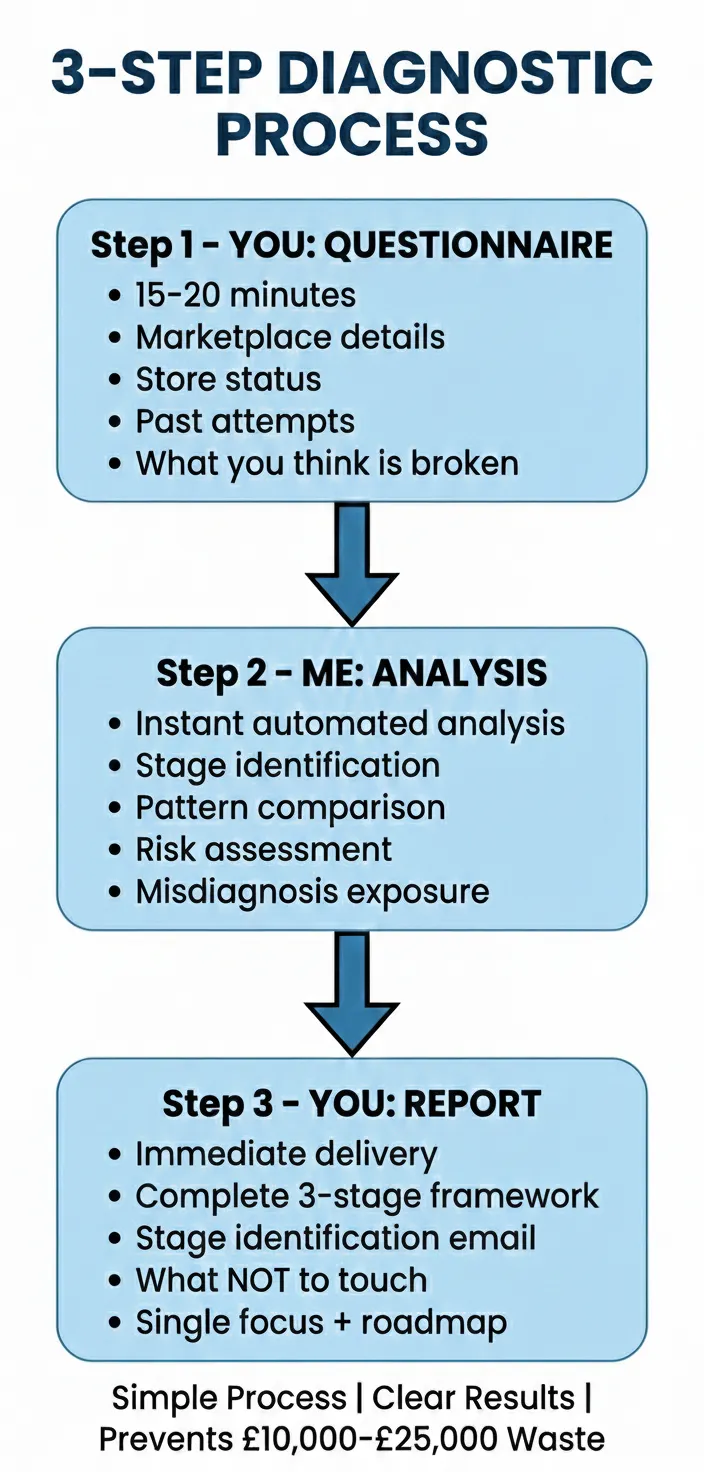
Step 1: The Questionnaire
After purchase, you answer a structured set of questions. This allows the system to see:
The stage you think you’re in
The stage your numbers actually indicate
Where expectations and reality don’t match
Which assumptions are costing you money
Step 2: The Analysis
Your responses are mapped against clear stage criteria. You’ll get clarity on:
Which stage you’re truly operating in
What’s normal for that stage
Whether anything is genuinely broken
Where money would help, and where it would be wasted
No guesswork. No interpretation required.
Step 3: The Report
You receive:
Clear stage identification
A defined focus for the next 90 days
Explicit “what NOT to touch yet” guardrails
The criteria you must hit before moving up a stage
You can reference it whenever you need clarity.
Step 1: The Questionnaire
After purchase, you answer a structured set of questions about:
Your marketplace history
Your current store status
Your traffic and conversion numbers
What you’ve already tried
What you believe is broken
Step 2: The Analysis
Your responses are mapped against clear stage criteria.
You’ll be told exactly:
Which stage you’re actually in
What’s normal for that stage
What you’re misdiagnosing
What not to touch yet
No guesswork. No interpretation required.
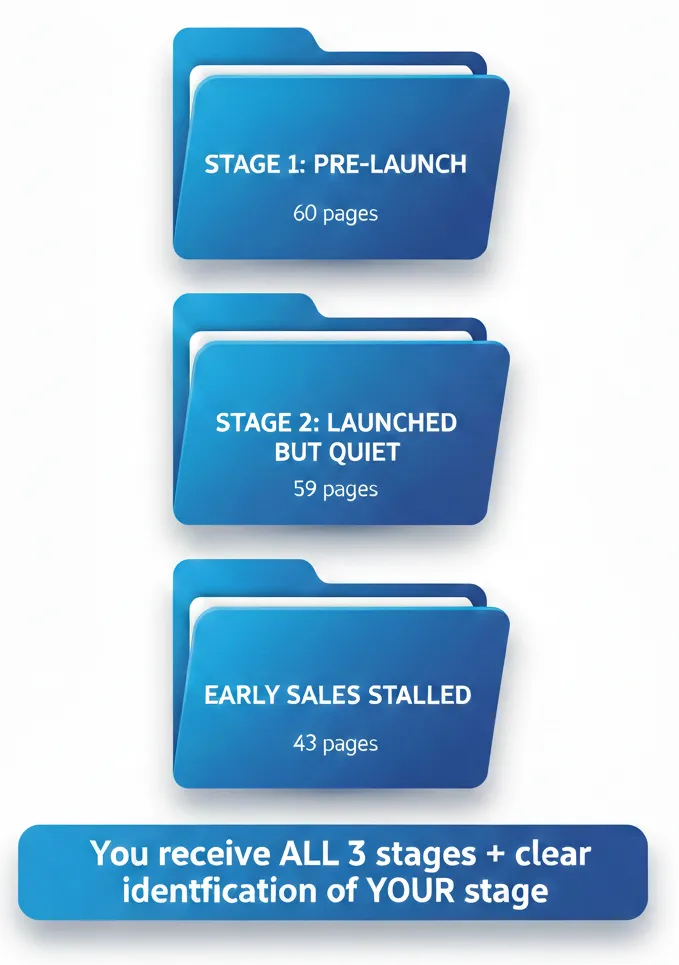
Why all three stages?
Because you need to see:
Where you actually are (your identified stage)
What got you here (the previous stage, if applicable)
What comes next (the following stage and its requirements)
This prevents you from skipping stages or operating with Stage 3 tactics when you’re still in Stage 1.
Why do I get all three stages?
Because you need to see:
Where you actually are (your identified stage)
What got you here (the previous stage, if applicable)
What comes next (the following stage and its requirements)
This prevents you from skipping stages or operating with Stage 3 tactics when you’re still in Stage 1.
What’s Inside Each Stage Report
Each stage manual is 40–60 pages. Practical. Stage-specific.
INSIDE EACH STAGE:
Stage Identification
The Real Work
Common Mistakes
What NOT To Do Yet
PROGRESSION CONTROL:
Stage-Appropriate Benchmarks
Guardrails
Exit Criteria
How You’ll Receive Your Stage Identification
Upon completing the questionnaire, you’ll receive:
Immediate email with subject line: “You Are In Stage [X]”
Direct access to all three complete stage reports
Clear guidance on which report to read first (your identified stage)
Context on why you’re in this stage based on your questionnaire responses
You can reference these reports repeatedly as you progress. They don’t expire. They’re yours to keep and revisit as you move through stages.
What This Diagnostic Is NOT
A disguised sales call
A technical website audit
A done-for-you execution plan
Ongoing consulting
A surface-level review
What You Get Instead
Clear stage identification
What’s normal for your stage
What you’re misdiagnosing
What NOT to touch yet
What actually moves you forward
Your Investment
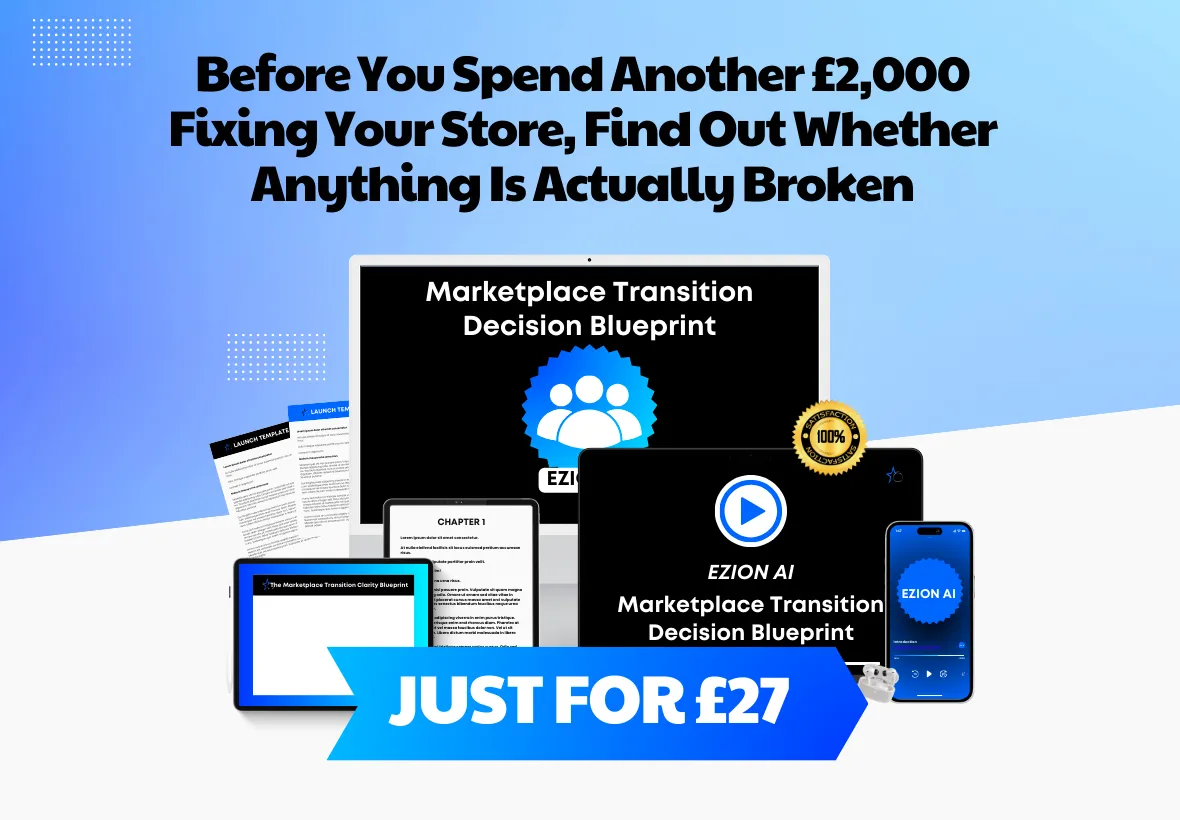
What’s included:
Complete 3-stage framework (160+ pages total documentation)
Your stage clearly identified via email
Stage-appropriate benchmarks for all three stages
Explicit “what NOT to do yet” lists for each stage
Exit criteria checklists
Common mistakes and guardrails
Immediate delivery (no waiting)
Permanent access to all materials
Delivered: Instant access upon questionnaire completion
✅ Immediate Delivery | ✅ Money-Back Guarantee | ✅ One-Time Payment
Why
£27?
This isn’t premium pricing.
It’s mistake-prevention pricing.
The goal isn’t to maximise revenue per buyer.
It’s to stop expensive errors before they compound.
I’d rather help 500 sellers avoid £10,000–£25,000 in waste at £27 each
than help 20 sellers at £297 once the damage is done.
The math is simple:
One wrong hire at £2,000–£5,000
pays for this 75–185 times over.
And that’s just one mistake.
Why £27?
This isn’t premium pricing.
It’s mistake-prevention pricing.
The goal isn’t to maximise revenue per buyer.
It’s to stop expensive errors before they compound.
I’d rather help 500 sellers avoid £10,000–£25,000 in waste at £27 each
than help 20 sellers at £297 once the damage is already done.
The math is simple:
One wrong hire at £2,000–£5,000
pays for this 75–185 times over.
And that’s just one mistake.

Here’s my promise to you:
If the diagnostic doesn’t give you absolute clarity on:
Which stage you’re actually in
What’s normal versus abnormal for that stage
What NOT to touch yet (and why)
What your focus should be right now
…then simply email me within 14 days and I’ll refund every penny. No questions asked, no forms to fill out, no hoops to jump through.
You’ll even keep the reports.
Why this guarantee?
Because I’ve seen what happens when sellers waste £10,000-£25,000 on wrong-stage solutions. I’d rather refund £27 than watch you make expensive mistakes that could have been prevented.
Frequently Asked Questions
Q: Who is this diagnostic for?
A: This is for marketplace sellers (Amazon, eBay, Etsy) who either:
- Have launched an owned store that’s quiet/stalled
- Are planning to launch an owned store soon
- Have a store with inconsistent early sales
- Are about to spend money on “fixes” but aren’t sure what’s actually broken
This is NOT for complete beginners who’ve never sold anything online, or established store owners doing £50K+/month who need advanced scaling tactics.
Q: Why do I get all three stages instead of just my stage?
A: Because you need context:
- Where you actually are (prevents operating at the wrong stage)
- What got you here (understanding the foundation you’ve built or missed)
- What comes next (knowing what to prepare for, not be surprised by)
Seeing all three stages prevents the most expensive mistake: skipping stages or applying Stage 3 tactics when you’re in Stage 1.
Q: How is this different from a generic audit?
A: Most website audits start with, “What can we fix?”
They look at design, speed, layout, copy, and give you a list of improvements. The assumption is that more optimisation equals better results.
The problem is that optimisation only works when you're solving the right problem at the right stage.
If you optimise too early, you waste money. If you add traffic before trust is stabilised, you burn budget. If you hire before clarity, you pay someone to implement confusion.
This diagnostic doesn’t ask what can be improved.
It asks what is dangerous to change right now.
That difference is what prevents £5,000–£10,000 in wrong-stage decisions.
Q: Is this really delivered instantly?
A: Yes. The moment you complete the questionnaire, the system:
1. Analyses your responses automatically
2. Identifies your stage
3. Sends you an email: “You Are In Stage [X]”
4. Gives you immediate access to all three stage reports
No waiting. No manual review. No delays.
Q: What if I disagree with my stage identification?
A: Then request a refund within 14 days. No questions asked.
However, in 18 months of running these diagnostics, disagreement usually means one of two things:
1. You’re comparing yourself to wrong-stage benchmarks (the reports explain why)
2. You’re emotionally attached to a solution you’ve already invested in (the reports expose this)
The most common feedback is: “I didn’t want this to be true, but you’re right. This explains everything.”
Q: Do I need to have a store already launched?
A: No. Pre-launch sellers (Stage 1) benefit significantly because they avoid building wrong-stage infrastructure.
Many pre-launch sellers waste thousands on:
- Premium themes they don’t need yet
- Advanced apps before they have traffic
- Complex integrations that create problems
- Custom development for features that don’t matter
The Stage 1 report shows you what “good enough” looks like for launch, saving months of overthinking.
Q: How long do the reports stay relevant?
A: Stage identification remains relevant for 3-6 months typically (how long most sellers stay in each stage).
The frameworks and benchmarks don’t expire.
The “what NOT to touch” lists stay relevant because they’re stage-specific, not time-sensitive.
As you progress to the next stage, you simply focus on that stage’s report. You already have it.
Q: Is this just common sense I could figure out myself?
A: The concepts seem obvious once explained (like most valuable insights).
If someone feels unwell, most symptoms are obvious. Fatigue. Headache. Pain.
What isn’t obvious is the cause.
Self-diagnosis usually treats the symptom. A proper diagnosis identifies the underlying issue.
Marketplace sellers do the same thing.
Low sales? Add traffic.
Poor conversion? Rewrite copy.
Silence? Redesign the site.
Those are symptoms. Not causes.
The diagnostic identifies your stage first. Then it isolates the real constraint at that stage.
That’s what removes guesswork.
Common sense tells you something is wrong.
Clarity tells you what not to touch and what to fix first.
Q: What happens after I get the diagnostic?
A: You implement based on your identified stage.
Your report gives you a clear 90-day focus, specific guardrails on what not to touch, and the benchmarks you need to hit before progressing. For most sellers, that alone removes enough noise to move forward with confidence.
If, later, you decide you want deeper support, there’s a Strategic Action Plan that maps out your transition in detail, and ongoing advisory if you want decision support as complexity increases.
But nothing is pushed.
No calls. No forced next step.
The diagnostic is built to stand completely on its own.
Your 1.5% Conversion Rate Isn’t A Problem
Before you spend thousands “fixing” your conversion rate, look at this:
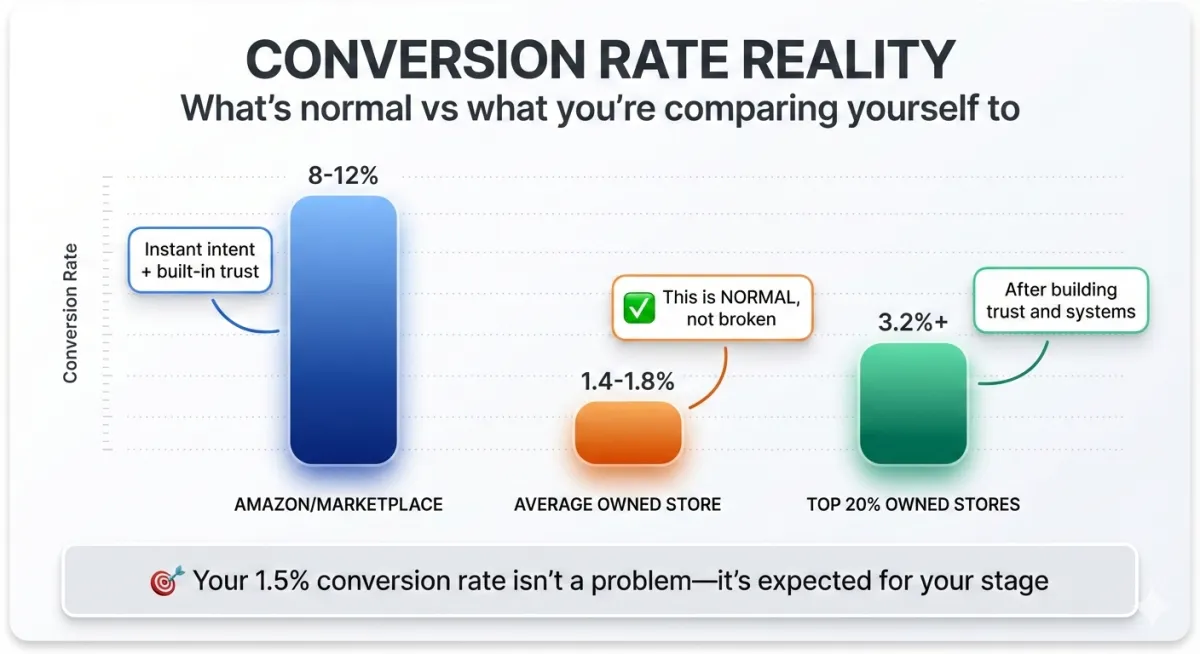
Amazon trains you to expect 8-12% conversion rates because:
- Buyers arrive with instant intent (searching with credit card ready)
- Built-in trust (Amazon brand does the heavy lifting)
- Compressed journeys (5 minutes from search to purchase)
Your owned store averages 1.4-1.8% because:
- Visitors arrive with no intent (scrolling social media, not searching)
- Zero inherited trust (unknown entity, “who is this?”)
- Extended journeys (days or weeks before purchase)
The top 20% of owned stores only hit 3.2%+ after building trust systems, email capture, and consistent touchpoints over months.
Your 1.5% conversion rate isn’t broken. It’s exactly where it should be for your stage.
You’re Standing At A Decision Point
Path 1: Continue Guessing
You can keep operating the way you have been:
Trying tactics that feel productive but don’t match your stage
Spending money on solutions to problems you don’t actually have yet
Watching your confidence erode as nothing seems to work consistently
Staying stuck in Stage 2 wondering what’s wrong with you
Path 1: Continue Guessing
You can keep operating the way you have been:
Trying tactics that feel productive but don’t match your stage
Spending money on solutions to problems you don’t actually have yet
Watching your confidence erode as nothing seems to work consistently
Staying stuck in Stage 2 wondering what’s wrong with you
Path 2: Get Stage Clarity
Or you can invest £27 in diagnosis before action:
Know exactly which stage you’re actually in (versus where you think you are)
Understand what’s normal versus broken for YOUR situation
Get explicit “what NOT to touch” lists that prevent £10,000-£25,000 in waste
Focus on the work that actually moves you forward
Stop guessing and start progressing with confidence
90 days from now, you’ll be moving towards the next stage with clarity, confidence, and minimal wasted spend.
The Choice Is Yours
But here’s what I know:
The sellers who succeed at marketplace-to-owned-store transitions aren’t the ones with the biggest budgets or the most traffic.
They’re the ones who get stage clarity before spending money, focus on stage-appropriate actions, and prevent expensive wrong-stage solutions.
P.S.
The £27 you invest in this diagnostic will either:
1. Save you £10,000-£25,000 in prevented waste (370-925x ROI),
OR
2. Give you absolute clarity that you get refunded within 14 days
Either way, you can’t lose. The only loss is continuing to guess.

Copyrights 2026 | EZION AI™
Privacy Policy | Terms & Conditions
This site is not a part of the Facebook website or Facebook Inc. Additionally, This site is NOT endorsed by Facebook in any way. FACEBOOK is a trademark of FACEBOOK, Inc.